
Small vs Big Prop Accounts… It’s NOT What You Think!
One interesting question came up in a trading discussion recently, and it really got me thinking:
Do traders perform better on smaller accounts or bigger accounts?
At first glance, the answer seems obvious. Bigger accounts mean more capital, larger payouts, and more opportunities… so surely they lead to better performance, right?
Not quite.
The reality is far more nuanced. Some traders thrive on small accounts, while others only become disciplined when trading larger capital. In fact, it’s common to see traders pass smaller accounts with ease—only to blow larger ones shortly after.
So what’s really going on?
Let’s break down the psychology behind it.
Why Small Accounts Can Feel Easier
Surprisingly, many traders perform better on smaller accounts.
The main reason? Less pressure.
When you’re trading a small account:
- You’re not emotionally attached to every trade
- You’re not thinking “this has to work”
- You’re simply executing your setups
That lack of pressure creates a kind of freedom. You stick to your plan, take cleaner entries, and let trades play out without interference.
And ironically, that relaxed mindset often leads to better performance.
But There’s a Catch…
The same lack of pressure can also backfire.
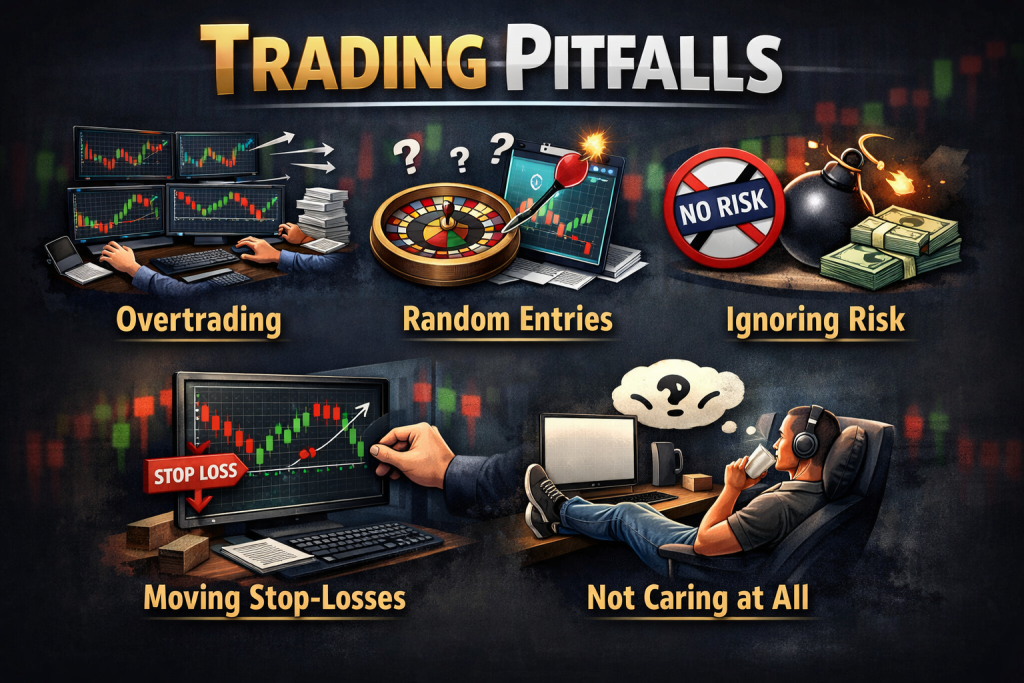
When the account feels “too small,” it’s easy to stop respecting it. That’s when bad habits creep in:
- Overtrading
- Random entries
- Ignoring risk
- Moving stop-losses
- Or just not caring at all
So while small accounts can improve execution, they can also destroy discipline if you’re not careful.
Why Bigger Accounts Feel Completely Different
Now let’s flip it.
The moment you see a large account balance, everything changes.
Suddenly:
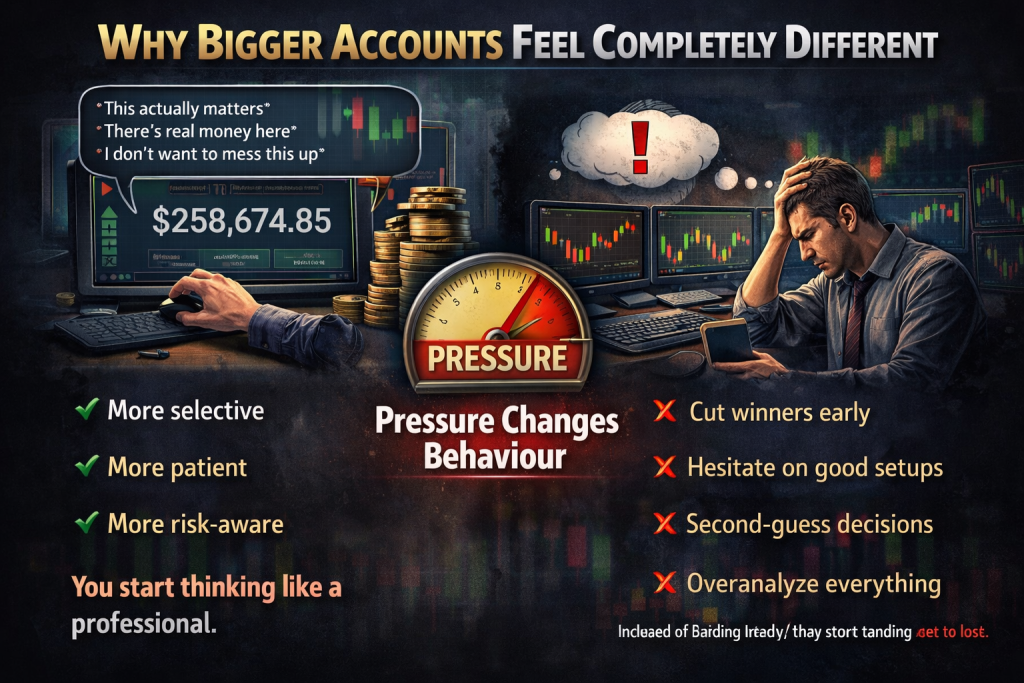
- “This actually matters”
- “There’s real money here”
- “I don’t want to mess this up”
This creates respect for the account—which is a good thing.
You become:
- More selective
- More patient
- More risk-aware
You start thinking like a professional.
But Here’s the Problem: Pressure
With that respect comes pressure—and pressure changes behaviour.
Traders on larger accounts often:
- Cut winners early
- Hesitate on good setups
- Second-guess decisions
- Overanalyse everything
Instead of trading freely, they start trading not to lose.
And that’s when performance drops.
Same Trader, Different Results
Here’s the key insight:
It’s not the strategy that changes—it’s the psychology.
The same trader, using the same system, can perform completely differently depending on account size.
Small account → relaxed, confident, consistent
Large account → cautious, emotional, inconsistent
That shift is everything.
How to Remove the “Money Factor”
So how do traders fix this?
1. Think in Percentages
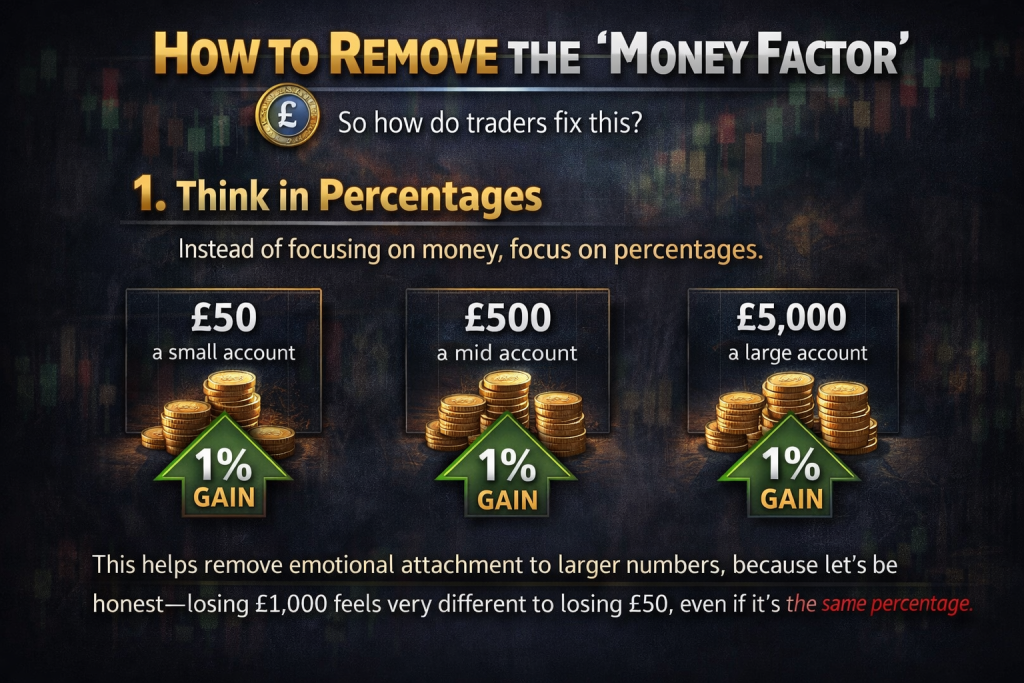
Instead of focusing on money, focus on percentages.
A 1% gain is a 1% gain:
- £50 on a small account
- £500 on a mid account
- £5,000 on a large account
It’s still 1%.
This helps remove emotional attachment to larger numbers, because let’s be honest—losing £1,000 feels very different to losing £50, even if it’s the same percentage.
2. Trade Copying
Another approach is to:
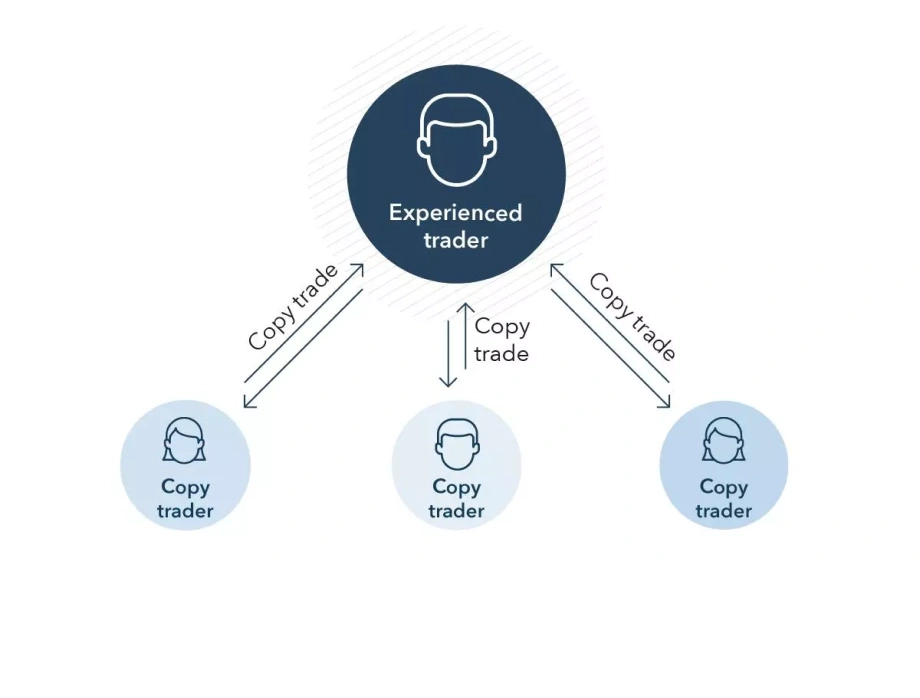
- Trade on a small account (where you’re relaxed)
- Copy trades to a larger account
This allows you to keep your calm mindset while benefiting from larger capital.
However, it’s not perfect.
One common issue is lot size rounding, where position sizes don’t scale exactly—leading to slightly higher risk on the larger account.
A common solution is fixed scaling, ensuring risk stays consistent across accounts.
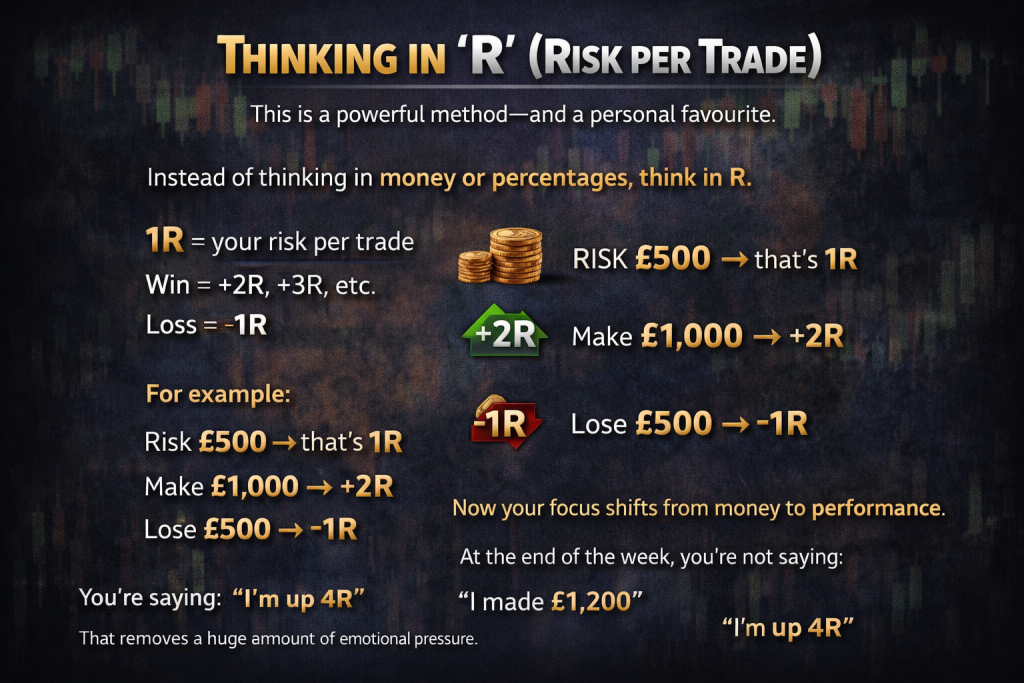
3. Thinking in “R” (Risk per Trade)
This is a powerful method—and a personal favourite.
Instead of thinking in money or percentages, think in R.
- 1R = your risk per trade
- Win = +2R, +3R, etc.
- Loss = -1R
For example:
- Risk £500 → that’s 1R
- Make £1,000 → +2R
- Lose £500 → -1R
Now your focus shifts from money to performance.
At the end of the week, you’re not saying:
- “I made £1,200”
You’re saying:
- “I’m up 4R”
That removes a huge amount of emotional pressure.
My Rule for Using R
Keep it simple:
- Set your R value
- Only adjust it once per month
No constant tweaking. No emotional changes.
Consistency is everything.
The Real Lesson
After speaking with different traders, one thing becomes clear:
There is no perfect account size—only the one that works for you.
Some traders thrive on small accounts.
Others need large accounts to stay disciplined.
But all experienced traders agree on this:
Risk management alone isn’t enough.
What really matters is:
- Patience
- Discipline
- Consistency
- Following your process
The Real Challenge: Performing Under Pressure
Trading is a lot like sport.
At the top level, everyone has similar technical skills.
But when pressure increases?
- Some people perform
- Others crumble
Trading is exactly the same.
The strategy might be identical—but the trader who controls their psychology wins.
Final Thought
So here’s the real question:
Do you trade better on small accounts or big accounts?
Personally, I perform best on smaller accounts and then copy trades across to larger ones.
But I know traders who are the complete opposite—they need bigger accounts to stay disciplined.
There’s no right answer.
Only what works for you.
If you enjoyed this, let me know your experience—small accounts or big accounts?
I’d be genuinely interested to hear your perspective.
Thanks
Stephen V
🏆 The5ers

The 5ers = 10% off new accounts… http://www.the5ers.com?afmc=xvc
🏆 FundedNext

FundedNext = 10% off accounts… https://fundednext.com/?fpr=stephen18
DISCOUNTS:
The 5ers = 10% off new accounts… http://www.the5ers.com?afmc=xvc
FundedNext = 10% off accounts… https://fundednext.com/?fpr=stephen18
FTMO accounts… https://trader.ftmo.com/?affiliates=qUaEypQAqkfVFbRJQxrt
Watch the YouTube video here
@online.prop.firms
Our Instagram: https://www.instagram.com/onlinepropfirms
https://www.instagram.com/onlinepropfirms/
https://www.instagram.com/onlinepropfirms/reels/